

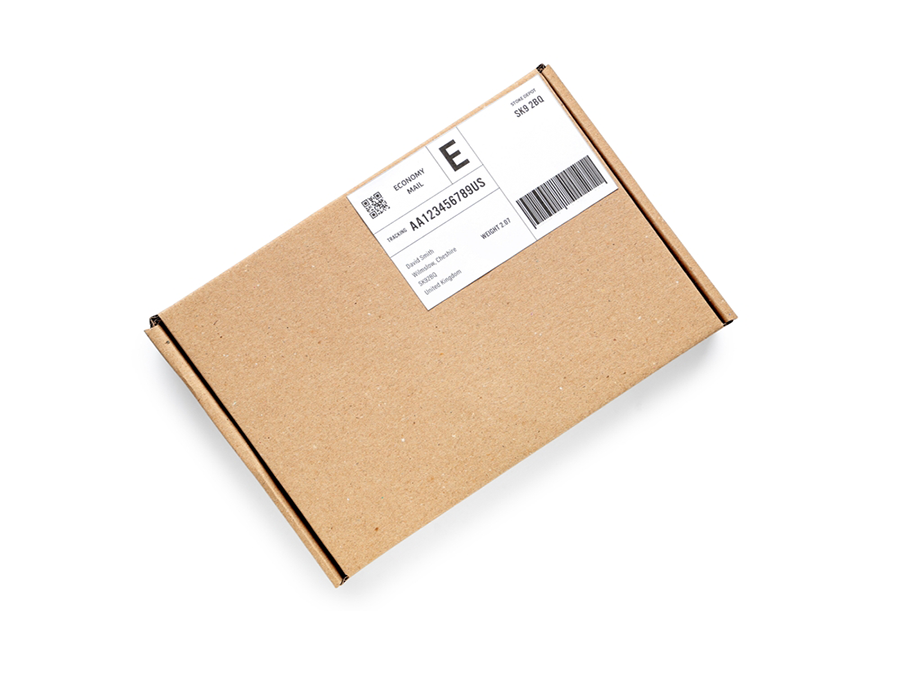
Many companies outsource fulfilment to third-party suppliers or manufacturers. They’ll take an order from a customer and arrange for the product to be dispatched directly to them by that third party.
However, problems can arise if the delivery does not appear to come from the company the customer ordered from. Unexpected branding or unfamiliar supplier details can cause confusion or undermine the customer’s confidence in the service.
In these situations, it is often preferable for the supplier to ship the product in plain packaging, without their own branding. The customer receives what they ordered, without any conflicting or unfamiliar identity. This is essentially what “white label delivery” or “white label dispatch” refers to, but let’s take a closer look at how and why it works.
What is white label delivery?

A simple example:
- Alice orders a red apple from Bob’s Apples
- Bob’s Apples takes payment and passes the order to Ruby’s Apples
- Ruby’s Apples fulfils the order and ships the apple directly to Alice
- The delivery arrives in plain packaging, with no reference to Ruby’s Apples
From Alice’s perspective, the experience remains consistent with the company she ordered from.
In practical terms, this usually means:
- Plain packaging with no supplier identity
- Brand-neutral dispatch notes with no pricing details
- No additional marketing materials included
- Delivery sent directly to the customer’s address
In the print industry, this model is widely used by:
- Print resellers
- Agencies and marketing teams
- Ecommerce businesses and Etsy sellers
It allows these businesses to offer products without operating their own production facilities, while maintaining a clear and consistent customer experience.
How does white label delivery benefit the print industry?
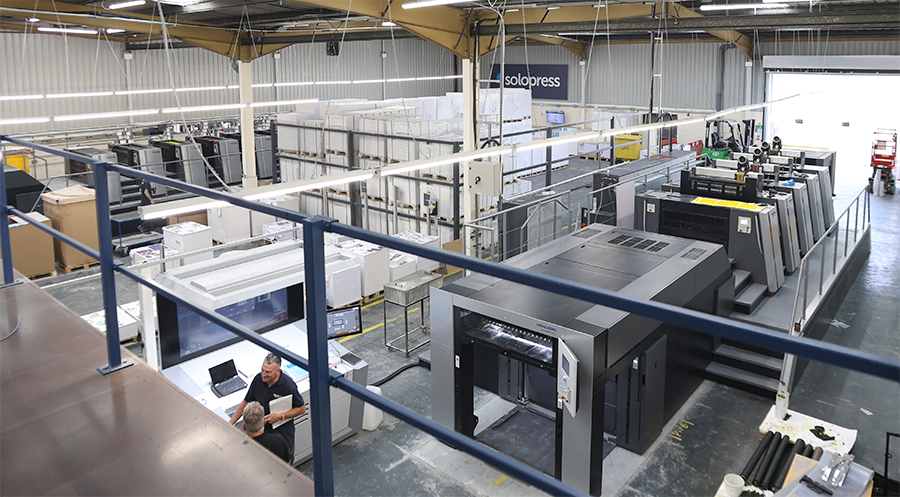
Many businesses sell print, but far fewer manufacture it. While the print industry features a number of large manufacturers such as Solopress, it also supports many successful companies supplying print without multiple factories filled with large, expensive presses.
In fact, print resellers make an important contribution to the industry as a whole, often specialising in niche areas. They are able to focus on a particular product area or audience, building expertise and relationships that hold real value to their end-users.
This model offers clear advantages. It allows businesses to remain agile and reduces the level of investment required, as setting up production in-house involves significant costs in equipment, space and skilled operators. These costs can be difficult to justify when demand is variable.
As a result, many businesses separate sales from production. In practice, that looks like:
- The reseller manages the customer relationship
- A print partner handles manufacturing
- The finished job is delivered directly to the customer
White label delivery allows this model to operate smoothly. It enables businesses to:
- Offer a broad range of products without owning machinery
- Take on work that exceeds their internal capacity
- Respond to fluctuating demand without overcommitting resources
Without it, the same model introduces risk:
- Supplier branding may reach the customer
- The supply chain becomes visible
- Control over the customer experience is reduced
White label delivery keeps production behind the scenes while allowing the customer relationship to remain clear and consistent.
The core business problem it solves
White label delivery addresses a simple but important issue: what happens when a product reaches your customer.
Protecting the customer relationship
If a supplier’s branding appears, it can create:
- Uncertainty about who fulfilled the order
- Doubt about who is responsible if something goes wrong
- An opportunity for the supplier to be identified and contacted directly
Even when the product is correct, this can undermine confidence in your service and weaken the relationship you have built.
White label delivery removes that point of friction. The order arrives as expected, with nothing to distract from your brand or the service you provide.
Avoiding unnecessary handling
Without white label delivery, orders often need to pass through your business before reaching the customer.
That can mean:
- Receiving deliveries from your supplier
- Checking and repackaging each order
- Sending items back out to the customer
Each extra step adds cost, increases lead times and introduces more opportunities for error.
This also makes the separation between you and your print supplier more visible, introducing risks that are difficult to manage once they reach your customer.
Supplier names or logos may appear on packaging. Dispatch notes may reference a third party. Pricing or internal details may be exposed.
By allowing orders to move directly from production to delivery, white label delivery keeps the process simple while maintaining a consistent customer experience.
Who benefits from white label delivery?

White label delivery is common in sectors such as retail, ecommerce, manufacturing and distribution, where businesses sell products without holding stock or managing production directly. In each case, the aim is the same: ensure the customer receives what they ordered, without confusion about where it has come from.
Applied to print, the same principle supports a variety of business models.
Print resellers and trade customers
For resellers, white label delivery is central to how the model works.
It allows you to:
- Retain full ownership of the customer relationship
- Offer a wide product range without holding stock
- Avoid the cost and time involved in double handling
As order volumes increase, the way those orders are processed becomes just as important as how they are fulfilled.
For example, Solopro allows customer orders to pass directly from your own ordering system into production. Jobs are then produced and dispatched under white label conditions as standard, without the need for manual re-entry.
This keeps fulfilment efficient while maintaining a consistent experience for your customer.
Agencies and marketing teams
Agencies often manage print as part of wider campaigns, where consistency and accountability matter.
White label delivery allows you to:
- Deliver printed materials without exposing suppliers
- Keep brand ownership intact across campaigns and merchandise
- Coordinate delivery to multiple locations from a single brief
Campaign work often involves repeat orders, tight deadlines and varied specifications.
In these cases, a service like Solopro helps manage ongoing print requirements more efficiently. Work can be handled with fewer steps, while white label delivery ensures materials arrive as part of the agency’s output, not a third party’s.
Ecommerce and online sellers
Across ecommerce, white label delivery underpins models such as print-on-demand and drop shipping.
It allows businesses to:
- Sell without holding inventory
- Dispatch directly to customers under their own brand
- Test new products without committing to stock
This applies across a wide range of products, from apparel and accessories to printed materials.
The principle remains consistent. Orders are fulfilled elsewhere, but the customer experience remains tied to the business they purchased from.
Branded merchandise suppliers
Where print sits alongside items like clothing, bags or drinkware, fulfilment can quickly become more complex.
White label delivery allows you to:
- Drop ship a wide range of products
- Maintain a consistent delivery experience
- Avoid managing fulfilment across different product types
This is particularly useful when orders include a mix of printed and promotional items, or when different suppliers are involved behind the scenes.
Franchises and multi-site businesses
For organisations with multiple locations, consistency and control are often the main concerns.
White label delivery allows you to:
- Centralise production while delivering locally
- Ensure consistent materials across all sites
- Remove the need for each location to manage suppliers
It also helps reinforce a shared identity across the organisation. Each location receives materials that align with the wider brand, without variation or conflicting supplier details.
In print, this approach can be supported by Brand Central, a centralised portal that gives individuals, locations or franchisees access to approved materials within defined templates. Orders are delivered directly under white label conditions, maintaining consistency across every site.
What to look for in a white label print partner

White label delivery is only as reliable as the partner behind it. If fulfilment is inconsistent, or if branding controls are not handled properly, the risks quickly outweigh the benefits.
When assessing a print partner, focus on how well they manage the practical details.
Reliable fulfilment
Orders need to be produced and dispatched accurately, every time.
Look for:
- Consistent turnaround times
- Clear production standards across different products
- A track record of handling repeat and high-volume work
Reliability matters more than speed alone.
Clear separation of branding
White label delivery depends on strict control of what the end customer sees.
Check that your partner:
- Uses plain or unbranded packaging as standard
- Removes all references to their own business
- Handles dispatch documentation carefully
Accurate documentation and tracking
You need visibility of each order, even if your customer does not see the supply chain.
Look for:
- Clear dispatch confirmation
- Tracking information shared with you
- Accurate delivery details carried through from order to fulfilment
Capacity to scale
As your business grows, your print partner needs to keep pace.
Consider:
- The range of products they can produce in-house
- Their ability to handle increased order volumes
- How they manage peak periods
Support for more complex workflows
As operations develop, simple order fulfilment often becomes part of a wider system.
It is worth considering whether your partner can:
- Handle multi-location deliveries
- Integrate with your ordering systems
- Provide account management for ongoing work
Bringing it all together
White label delivery supports business models where sales and fulfilment are handled separately, keeping production out of view without disrupting the customer experience.
As print moves across different workflows, whether direct to customer, across locations or through automated systems, consistency of presentation becomes more important.
Without it, visible supply chains and additional handling introduce unnecessary friction. With it, orders move from production to delivery as expected, while the customer relationship remains clear.

 English